


The AI agent illusion: why alignment comes before acceleration and autonomy
Most companies are racing to adopt AI agents without fixing their fractured workflows, creating fragile, unsustainable systems. In this blog, I explain why Alignment—standardizing tools, workflows, and oversight—is the non-negotiable first step before organizations can accelerate with AI or achieve true autonomy. Kaamfu is built differently: we align midline managers by consolidating core work functions into a single, frictionless control layer, ensuring AI enhances productivity instead of amplifying chaos. Alignment is the foundation of autonomy.
There’s a meme making the rounds that captures a hard truth about today’s AI adoption frenzy. It shows an elephant labeled “Entire Global Economy” balancing precariously on a beach ball labeled “AI Agents.” Beneath, a few ants—named JSON, FastAPI, and a desperate “Plz Bro, do not hallucinate”—are straining to hold it up.
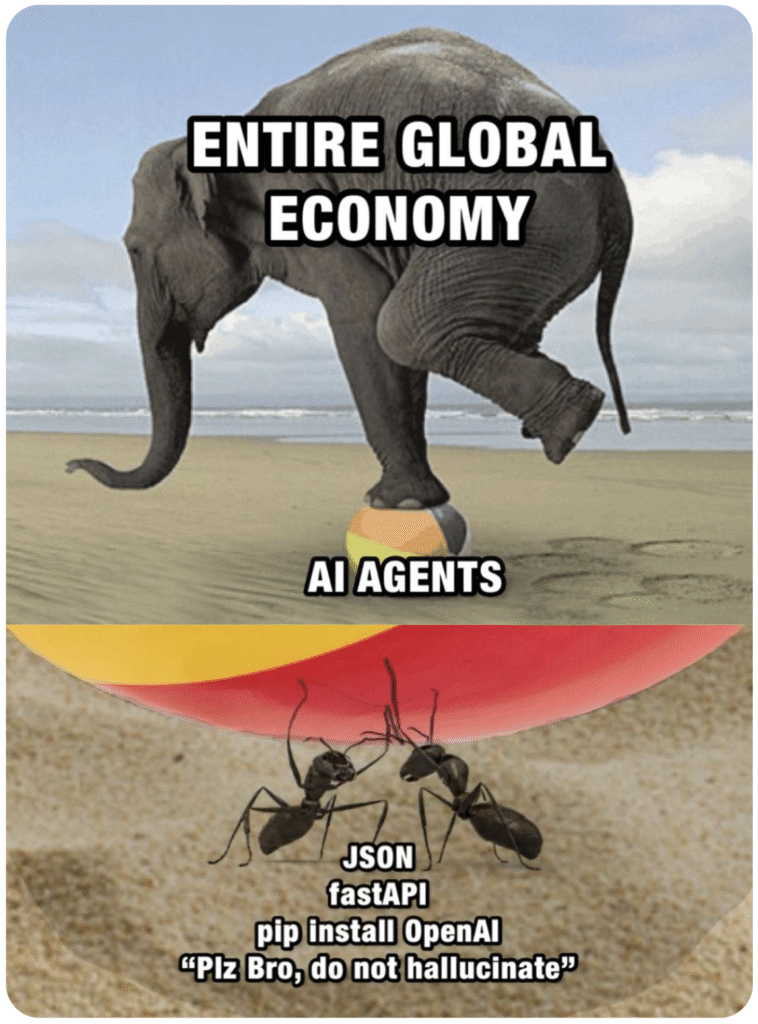
It’s funny because it’s true. But it’s also a warning.
Many organizations are charging into AI thinking that bolting on agents will fix their problems. What they don’t realize is this: AI doesn’t fix chaos—it amplifies it. If your foundation is shaky, if your workflows are fragmented, AI will only make the cracks wider. The current trend of layering AI onto disjointed systems without structural alignment is the fastest way to create a brittle, unstable operation.
The Autonomic Framework: Align → Accelerate → Autonomize
In my Autonomic Framework, there are three critical phases that an organization must move through to achieve true AI-driven autonomy:
- Align – Standardize the tech stack, structure workflows, and ensure clarity of control and visibility across the organization.
- Accelerate – Introduce AI to enhance speed, reduce friction, and automate repetitive oversight—but within the boundaries of an aligned system.
- Autonomize – Scale AI agents to handle execution with minimal human intervention, while maintaining alignment and strategic oversight.
Skipping alignment is like building the 100th floor of a skyscraper before laying the foundation. The current AI hype cycle is filled with companies doing just that—rushing to autonomous workflows without the groundwork to support them.
Real-World Example: Aligning the Manager’s Workspace
One of the clearest examples of this misstep is in managerial tooling. Most companies fail to recognize that managers and supervisors—the “midline”—are not overwhelmed because of a lack of AI agents. They’re overwhelmed because they are trapped in tool juggling and data chasing.
At Kaamfu, we identified where managers spend 90% of their time:
- Chasing status updates across tools
- Digging through siloed data
- Switching between chat, task boards, time trackers, and spreadsheets
- Trying to maintain visibility on team performance
We realized that frontline workers will always use multiple tools, and that’s fine. The problem is that managers are forced to follow them through every one of those tools to get the data they need to drive outcomes.
Our approach is different. Kaamfu serves as the control center where outcomes are aligned, tracked, and optimized. Frontline workers continue using specialized tools for their tasks, but they always return to Kaamfu to report outcomes. This ensures that midline managers are no longer playing an endless game of tool-chasing.
By consolidating chat, task management, time tracking, worker monitoring, team management, and performance tracking into a single frictionless environment, we reduce tool-switching, surface critical insights in real time, and allow managers to focus on driving productivity and alignment—not juggling tools.
This is alignment in practice. It’s not glamorous, but it’s the prerequisite to any meaningful AI deployment. Once managers operate in an aligned environment, AI can accelerate their workflows. Until then, AI agents added on top of fragmented systems only create more noise.
Kaamfu’s Foundational Advantage: Built for Alignment First
Kaamfu wasn’t built to patch the problem—it was designed from the ground up to solve it. This is the product of 25 years of R&D in workspace optimization. Every piece of Kaamfu’s architecture is engineered to eliminate unnecessary friction—minimizing clicks, reducing data scatter, and ensuring that oversight is structured and effortless.
When companies struggle with AI hallucinations, broken rule enforcement, and unpredictable behavior, it’s often because they skipped alignment. They didn’t build a control layer where AI could operate with confidence.
Kaamfu’s integrated stack ensures that AI agents don’t need to guess—they work within a structured, aligned, and outcome-driven environment.
The Road to Autonomy Starts with Alignment
Alignment isn’t the most exciting phase in an AI transformation journey. It’s not flashy. But it’s where organizations either lay the groundwork for scalable AI-driven operations or set themselves up for constant firefighting.
The companies that get this right will accelerate smoothly into AI-driven workflows. The ones that don’t will be trapped in a cycle of patchwork solutions, burning time and resources chasing problems their AI agents inadvertently created.
At Kaamfu, we’re ahead of the curve because we’ve always prioritized alignment first. Only when structure and control are in place does acceleration—and eventually autonomy—become sustainable.
…
Every organization is in the race to autonomy
Autonomization is not a distant future. The race is on, and the organizations preparing today will be the ones that win tomorrow.