

Reintroducing human cycles into business planning

Modern business calendars assume human capacity is flat, scheduling work without regard for natural fluctuations in motivation and clarity. I believe this is a mistake. By introducing Animus Intensity as a vertical axis and mapping it against time on a standard calendar, clear patterns emerge. Animus follows two predictable cycles: a slow solar rhythm across the year and a faster lunar rhythm each month. Aligning planning and decisions with these cycles reduces friction, prevents burnout, and enables more sustainable and predictable execution.
Every business needs planning cycles. We decide when to launch, when to hire, when to push, when to rest, when to review, and when to commit. Yet most of these decisions are made inside calendars that were never designed to reflect human capacity.
Before 2026, my own approach was typical. I set schedules around holidays, fiscal quarters, availability, and convenience. Some cycles were weekly, some quarterly, some annual. They were pragmatic, coordinated, externally sensible, and symmetrical. What they were not was biologically, psychologically, or energetically informed.
The assumption underneath most business calendars is simple and rarely questioned: human motivation and capacity are flat enough to be ignored. Any variation is treated as noise, personal weakness, or a discipline problem. Planning assumes that if the calendar says “execute,” execution should occur.
But that assumption breaks down quickly in practice. Founders feel it. Leaders feel it. Teams feel it. Motivation surges and collapses for reasons that are not captured in sprint plans or OKRs. Decision quality fluctuates. Creativity arrives and disappears. Some weeks feel naturally suited to commitment and outward motion. Others feel better suited to review, consolidation, or restraint.
Most organizations treat these variations as problems to overcome. I began to treat them as signals to map.
The Missing Axis in Business Calendars
What most calendars are missing is a vertical axis. Time already exists horizontally. Days, weeks, months, and years advance. But calendars rarely plot anything vertically other than workload density. They do not plot internal drive, motivation, or expressive force.
I needed a way to represent something I could clearly feel but had never formally named. It was not mood, emotion, happiness or stress. It was the intensity with which I wanted to act, express, decide, and project myself outward. I call this Animus Intensity.
Animus Intensity is the internal force that governs whether effort feels natural or strained, whether decisions feel obvious or premature, whether expression wants to move outward or remain internal. It exists independently of obligation or mood. You can have high animus intensity and choose restraint, or low animus intensity and still force action, but the cost is different.
This becomes the vertical axis of the calendar, while time remains the horizontal axis. Once those two axes exist, patterns begin to emerge.
Two Cycles, Not One
What became immediately obvious is that there is not a single rhythm governing animus intensity. There are at least two.
The first is a low-frequency solar cycle. Across the year, animus intensity naturally rises from winter toward summer and falls again toward winter. This is not metaphorical. It aligns with light exposure, temperature, activity levels, and long-observed seasonal human behavior patterns documented across agricultural and medical history. On a 10-point Animus Intensity scale, winter represents the lower bound and summer the upper bound.
The second is a higher-frequency lunar cycle. Within each month, animus intensity oscillates. It tends to be lowest near the new moon, when inwardness and consolidation dominate, and highest near the full moon, when expression, decisiveness, and outward projection peak. This oscillation repeats independently of the season, moving up and down along that same 0–10 scale.
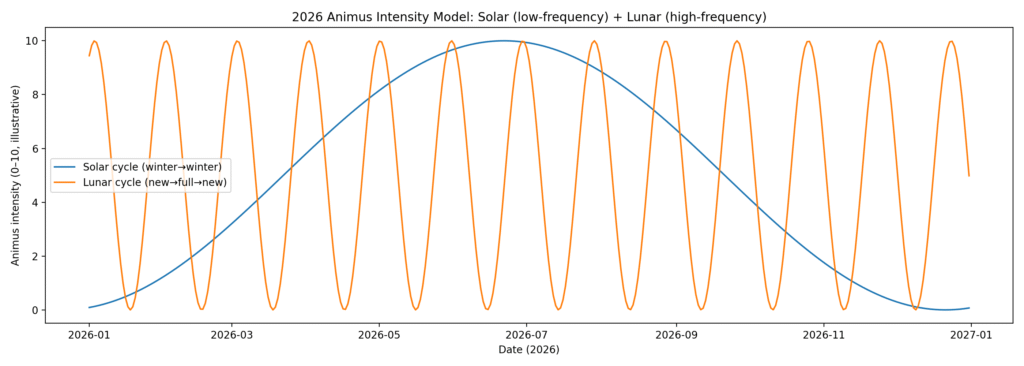
These two cycles do not compete, but they do stack. The solar cycle defines the baseline, and the lunar cycle amplifies it. This means a full moon in summer is not the same as a full moon in winter. The vertical height available to that peak is different. Likewise, a new moon in summer still carries more available force than a new moon in winter.
When these cycles are plotted together, they form a continuous waveform that maps internal drive across the year.
Why This Matters for Operations and Decision-Making
Once this overlay exists, planning changes. Certain decisions clearly benefit from high animus intensity: launches, commitments, negotiations, public communication, and decisive directional shifts. Other activities benefit from lower animus intensity: review, correction, system refinement, internal thinking, and recovery.
Without this model, these decisions are scheduled arbitrarily. With it, they can be aligned.
This does not mean becoming passive or surrendering discipline. It means choosing when to push and when to contain with greater precision. It means distinguishing between effort that compounds and effort that depletes. For a company, this opens the door to calendars that do more than coordinate tasks. They begin to coordinate capacity.
It also reframes fatigue. Burnout is often not the result of too much work, but of sustained misalignment between required output and available animus intensity. A calendar that anticipates this can prevent it rather than react to it.
Acceptance Comes Before Use
For any of this to be useful, there is a prerequisite that cannot be skipped. One must first accept that these natural cycles exist, and believe that aligning with them can improve outcomes rather than limit them. That acceptance did not come easily to me.
For most of my adult life, I lived as though the year were a single, uninterrupted spring. I was always planting, initiating, and pushing forward. New ideas, new projects, new systems, new directions. There was little sense of harvest, little permission for rest, and almost no space for reflection that was not immediately followed by another push.
In hindsight, this maps cleanly onto what I see in the United States more broadly. It is a culture of constant motion, continuous growth, and perpetual urgency. There is a strong assumption that stopping is failure and resting is falling behind.
I stepped away from that environment early in my life when I moved to India. Externally, my life slowed and I lived closer to the land, and natural constraints of the seasons. While my day-to-day environment was simpler and more grounded, internally I carried the same constant vernal cycles with me.
It was only in my mid-forties that I began to see the cost of that mismatch. The damage was not dramatic or sudden, but cumulative. I experienced a subtle erosion of clarity, patience, and internal coherence. I was living in a seasonal world while demanding year-round activation from myself and those around me.
Today, my life in India is deliberately simple and closely tied to the seasons. I notice the cold, the heat, the length of days, the natural slowing and quickening of life around me. When I allow myself to rest when rest arises, and to act when action feels natural, but do so with the understanding that these states are part of larger cycles rather than personal whims, something changes. The rest produces clarity rather than guilt, and my action feels cleaner and more decisive.
I did not take this on faith. To convince myself this was real, I began tracking. I plotted the solar and lunar cycles alongside daily check-ins across different parts of my day. I logged my decision-making clarity, desire to act, willingness to express, and what I termed my “animus intensity”. After a few cycles, the pattern was unmistakable that my internal drive fluctuated predictably with these two cycles, regardless of circumstance.
Since I spend most of my waking hours working, the question became unavoidable: if my internal capacity follows these rhythms anyway, why would I plan my work as if it did not? This calendar is the result of that realization. It is not an attempt to escape responsibility or effort, but an attempt to stop pretending that humans operate independently of the same cycles that govern everything else. The experience for me has been much less friction and more predictable growth.
Introducing a Different Kind of Calendar
By plotting animus intensity vertically and time horizontally, and by overlaying solar and lunar cycles, it becomes possible to anticipate internal conditions with a useful degree of reliability. Not with certainty, but with enough signal to make better decisions about when to initiate, when to commit, when to review, and when to rest.
The calendar does not dictate behavior, but it forecast context. It can allow leaders to ask better questions before forcing answers. Is this resistance a discipline issue, or a timing mismatch? Is urgency intrinsic to the situation, or imposed by a flat calendar that ignores human rhythm? Is this a moment for outward force, or for consolidation and restraint?
In 2026, I am no longer scheduling as if all days are equal and all weeks interchangeable. I am introducing a calendar that reflects how people actually operate, not how spreadsheets assume they do. It acknowledges cycles that have always been present, whether we named them or not, and uses them to reduce friction, preserve clarity, and support more predictable, sustainable growth.
…
Every organization is in the race to autonomy
Autonomization is not a distant future. The race is on, and the organizations preparing today will be the ones that win tomorrow.