

The genres we don’t have names for

We have names for Romance, Sci-Fi, and Horror because naming genres helps audiences find what they want and avoid what they don’t. But two of the most common content categories in film, television, and marketing have no names yet. This post proposes two: Genderfi and Racialfi. Not as criticism, not as culture war, just as an honest labeling request that would serve everyone better than the current system of stumbling in and arguing about what you found.
I came across a LinkedIn post recently that stopped me mid-scroll. It showed a fictional corporate C-suite, nine executives, colorful illustrated portraits, each with a sardonic caption about what “doing AI” means to their function. The image was clever and the insight was real. But what caught my attention was the demographic composition of that leadership team.
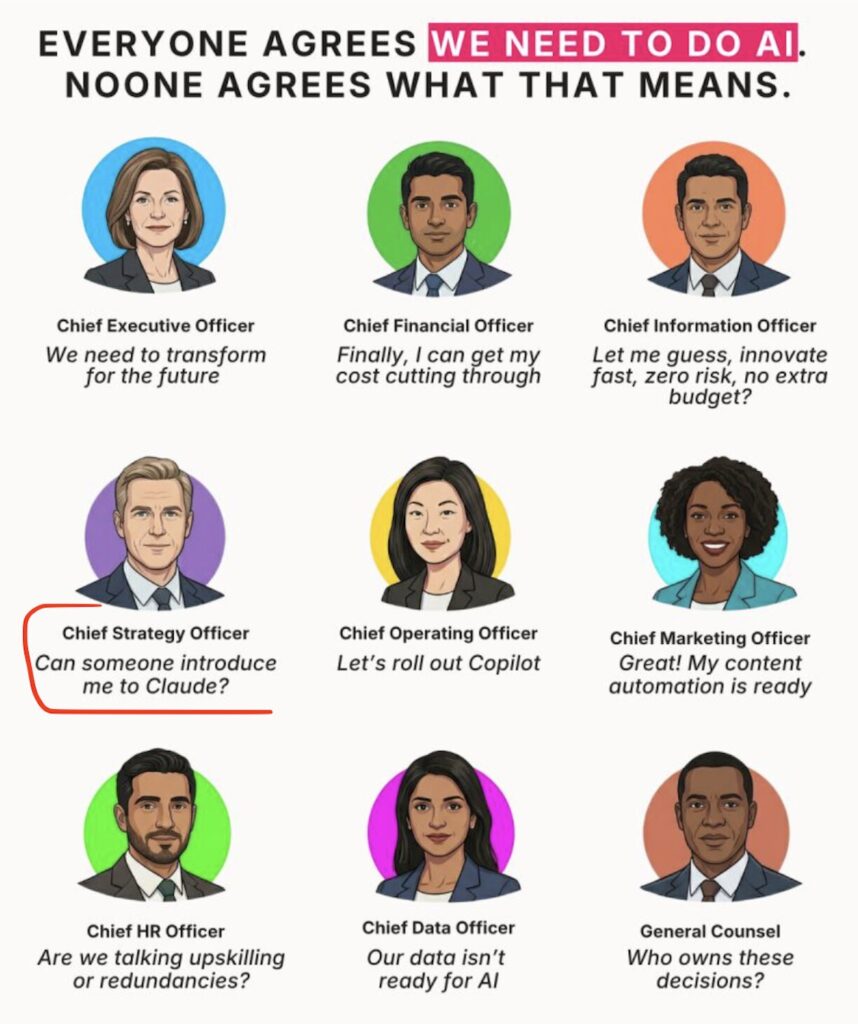
Of the nine executives depicted, five were women, five or six were people of color, and there was a single white male in the group. He was the Chief Strategy Officer, and his caption clearly revealed him to be the most clueless one in the room. Now contrast that with reality. Studies consistently show that around 85 to 90 percent of Fortune 500 CEOs are white men. Women hold roughly 10 to 15 percent of C-suite roles overall. Racial diversity at the senior executive level lags significantly behind even middle management. Run the numbers on the probability of a real corporation naturally producing that exact leadership composition and you land somewhere between one in two thousand and one in five thousand.
And if you’re struggling to think of a real company that actually looks like that image, you’re not alone. It’s genuinely difficult to find a private sector corporation where gender diversity and racial diversity intersect at that level simultaneously across the full C-suite. You might find pockets of it in nonprofits, government-adjacent organizations, or certain healthcare systems. But a Fortune 500 with that exact composition? It essentially doesn’t exist yet. Which is precisely what makes the image fiction rather than forecast.
That’s not a criticism of the post. It’s a genre note. And it crystallized something I’d been trying to articulate about my experience on Netflix, Prime, and pretty much every other content platform. With striking regularity, I find myself twenty minutes into something that looked like a thriller or a drama, only to realize the world on screen operates by a different set of rules than the one I actually live in.
For example, I’ll start a film that looks interesting and within the first twenty minutes I realize I’m watching a world where the men are helpless, incompetent and indecisive. Or where the historical figures look nothing like the historical record. Or where every position of authority is cast in a way that feels less like a story and more like a reimagining of reality. I don’t get angry, but I do instantly disengage, because the world on screen doesn’t ring with my experience of reality.
Here’s what I’ve landed on: this is a genre problem, not a values problem.
We already know how to handle genres we don’t personally connect with: we don’t watch them. I don’t like romance stories, so I don’t seek them out and consume them. Genres make a promise to a specific audience: this is the world as we wish it were, or find it entertaining to imagine, and audiences self-select accordingly.
The content I keep stumbling into on streaming platforms has a specific audience too. That audience finds it aspirational, satisfying, or simply entertaining to see gender roles reversed, or historical figures reimagined, or organizational hierarchies redistributed. That’s completely legitimate. The problem is that it’s unlabeled, so audiences who aren’t interested in that content keep wandering into it without warning, and then the conversation turns into a culture war when it should just be a genre conversation.
So I want to name it: Genderfi is fiction where traditional gender roles are reversed or subverted as a creative premise, and Racialfi is fiction where racial composition is reimagined, historical figures recast, cultural contexts remixed. These are real genres with real audiences who deserve to find their content easily. On the same note, audiences who’d prefer something else deserve to know what they’re selecting before they’re twenty minutes in.
The LinkedIn post wasn’t wrong to use a diverse fictional C-suite as its visual. It was a creative choice for a specific audience. I just think we’d all be better off if we called it what it is rather than presenting it as documentary realism and then acting confused when part of the audience doesn’t connect with it or gets offended.
Which brings me to a direct request for Netflix, Prime, and every major content platform: label your genres better. You already have genre tags for Romance, Sci-Fi, Horror, Gay & Lesbian, and Documentary. Genderfi and Racialfi are just as real as any of those categories, with just as distinct an audience. Tagging them clearly doesn’t diminish the content or its audience. It actually serves that audience better, because people who actively want that experience can find it faster. And it stops the rest of us from feeling like we are being actively written out of stories about a civilization we had a significant hand in building.
We name things so we can talk about them clearly and so people can find what they’re actually looking for. These genres are already everywhere. They just don’t have names yet.
…
Every organization is in the race to autonomy
Autonomization is not a distant future. The race is on, and the organizations preparing today will be the ones that win tomorrow.