

The 10 year shift from human effort to machine effort

In this blog I explain that the real impact of AI over the next decade will not be incremental productivity gains, but a structural redistribution of effort inside organizations toward full autonomy. Today, nearly all operational energy is carried by humans, but over a 10-year horizon, machine systems will progressively absorb repetition, supervision, coordination, and eventually elements of orchestration. This shift follows a predictable ladder, beginning with rule-based tasks and moving upward toward enterprise-level optimization. Organizations that unify data, clarify roles, and design for machine legibility will accelerate faster, especially smaller firms. Ultimately, competitive advantage will come from continuous insight harvesting and accelerated decision-making, first supported by machines, then increasingly executed by them within defined constraints.
There is a structural transition underway that will redefine how organizations function over the next decade. Most public conversations about AI fixate on tools, features, and incremental productivity gains, but that framing is too narrow. The deeper shift is not about better software or smarter assistants, but about where effort resides inside the enterprise, who carries it, and how that distribution of operational energy fundamentally changes the design and performance of the organization.
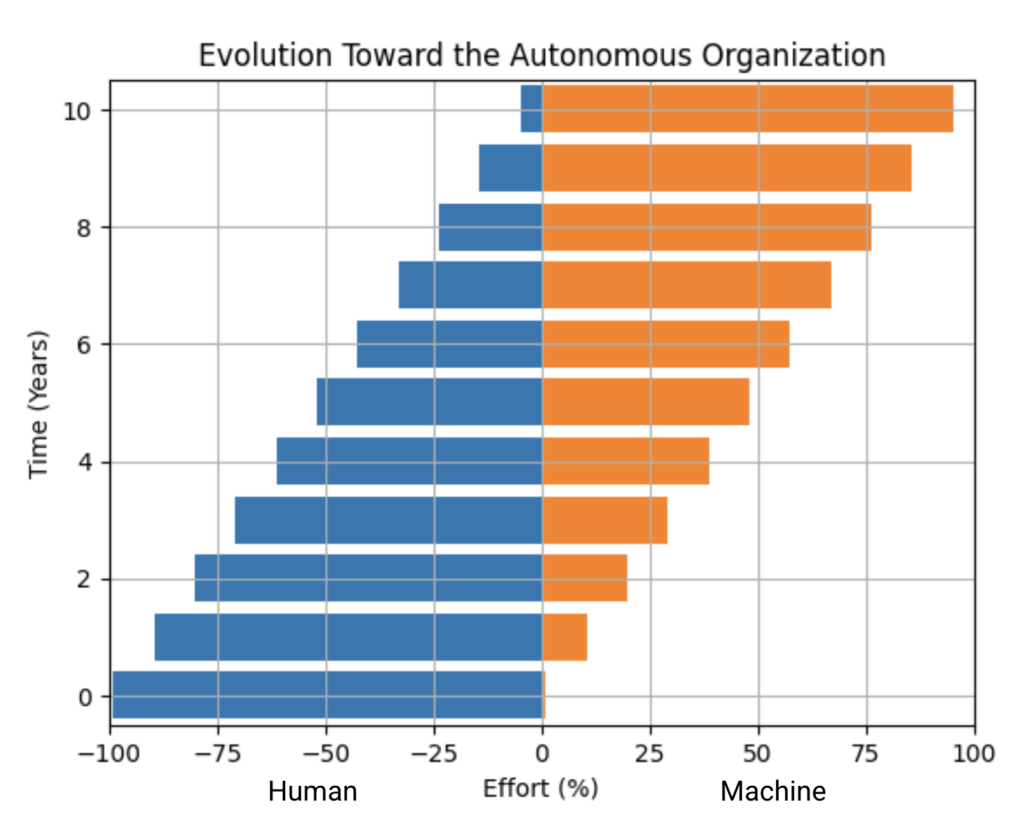
The chart above models a 10-year horizon in which the balance of operational energy moves from almost entirely human-driven to predominantly machine-driven. At year zero, which represents today, roughly 99 percent of effort is human and only 1 percent is machine or agentic. By year ten, in this model, that ratio approaches 5 percent human and 95 percent machine.
This is a model of effort composition, not a prediction of job counts. It describes where cognitive and procedural energy will reside within an idealized, evolving organization. The exact timing will differ by industry, culture, and capital structure. Smaller organizations will move through this curve faster than large incumbents. That asymmetry alone may give rise to startup organizations incubated by larger enterprises but structurally independent, moving ahead without legacy friction.
Understanding What “Effort” Means
When I refer to effort, I am not talking about payroll distribution or headcount ratios. I am talking about operational energy expended to achieve goals. Effort includes monitoring, coordinating, reconciling, enforcing, reporting, routing, interpreting, escalating, and deciding. It includes the invisible vigilance that keeps systems aligned.
Today, nearly all of this energy is carried by humans. Managers chase updates. Supervisors manually reconcile dashboards. Employees cross-check tools. Leaders carry unresolved decisions in their heads. Much of this effort is necessary, much of it is also low leverage and structurally automatable, even before modern AI.
Machine systems are uniquely suited to absorb repetition, vigilance, and structured execution. They do not fatigue, forget, or lose context between meetings. As their capabilities mature, they steadily take on more of this burden.
The left side of the chart represents human effort gradually being relieved of that load, starting with these lower-leverage roles. The right side represents machine effort expanding into structured execution and orchestration. Again, this is not replacement of people, but it is redistribution of work types.
The 10 Types of Work Machines Absorb
To understand how this transition unfolds, we must look at the types of work that move first. Machine effort climbs a ladder of replaceability, starting at the bottom with deterministic repetition and moving upward toward orchestration and leadership. They absorb specific categories of work in a predictable order, beginning with the most structured and repetitive and gradually moving upward into coordination, supervision, and eventually strategic orchestration. If we want to understand how the 10 year transition unfolds in practice, we need to examine that progression directly.
The clearest way to do that is to break down the types of work machines absorb, as shown in the table below.
| Level | Title | Core Function | Scope of Control | Example Behavior |
| 1 | Analytical | Gathers, summarizes, and visualizes data without changing system state. | Read-only informational access. | “Show me what John did in the past three hours.” |
| 2 | Instructional | Executes specific, rule-bound commands when directly instructed by a human. | Single operation, single context. | “Pause John’s shift now.” |
| 3 | Actioning | Monitors conditions and performs predefined actions automatically. | Conditional execution within a defined rule set. | “If John does not close this task by 2 PM, pause him and notify me.” |
| 4 | Task Overseer | Supervises the lifecycle of a single task, ensuring progress, resolving blockers, and maintaining schedule adherence. | Single task or workflow. | Keeps a specific task unblocked and progressing until completion. |
| 5 | Multi-Task Overseer | Manages several tasks concurrently, coordinating dependencies and balancing priorities. | Multiple related tasks. | Adjusts timing and allocation to prevent bottlenecks across a small workstream. |
| 6 | Goal Supervisor | Oversees clusters of tasks that contribute to a shared goal, detecting misalignment and escalating when needed. | Goal-level grouping. | Monitors goal progress and intervenes when deliverables are at risk. |
| 7 | Workstream Manager | Coordinates across goals and teams, reallocating resources to sustain flow and performance. | Cross-team, multi-goal alignment. | Rebalances assignments across workers or squads to maintain throughput. |
| 8 | Organizational Orchestrator | Supervises entire departments or functions, reprioritizing resources to resolve systemic issues. | Departmental or functional scope. | Detects underperforming units and redistributes workloads or goals. |
| 9 | Enterprise Controller | Integrates and optimizes all organizational workstreams, ensuring alignment between strategic objectives and operational execution. | Full-enterprise oversight. | Continuously aligns projects, budgets, and timelines to enterprise KPIs. |
| 10 | Agentic CEO | Operates as a fully autonomous organizational intelligence—setting strategy, allocating capital, and driving execution across the entire ecosystem. | Enterprise and ecosystem. | Defines vision, adjusts budgets, and orchestrates all actors—human and artificial—toward collective objectives. |
What this table makes clear is that machine expansion is not random and it is not uniform. It follows structure. The work that moves first is the work that is rule-based, repetitive, and measurable. As systems mature, they climb into supervision, coordination, and eventually orchestration. The higher the level, the more it depends on clean data, clear goals, defined authority, and explicit governance.
The lower levels are already being absorbed across industries and the middle levels are actively being built into operational platforms. The highest levels remain aspirational and will require not just better models, but better institutional design. Whether an organization reaches Level 6 or Level 10 will depend less on raw technology and more on how intentionally it structures itself to be machine-legible.
In other words, the question is not whether machines will climb this ladder, but how far your organization is structurally-prepared to let them climb.
How the 10-Year Transition Unfolds
Once you understand the ladder of replaceability, the 10-year curve becomes less abstract. The transition from human effort to machine effort is not a vague acceleration of automation. It is a staged ascent up that ladder. Machines climb level by level, and each climb changes how the organization allocates energy.
The speed of this climb depends on structural readiness. Organizations with unified systems, clean data, and clearly defined roles will move upward faster. Those with fragmented tools and ambiguous accountability will stall at lower levels. The timeline below describes an idealized progression, not a guarantee. Some companies will compress it into five years. Others may take fifteen. But the sequence itself is predictable.
Years 0 to 2: Levels 1 to 3 – Relief of Repetition
The first wave is mechanical. Machines absorb analytical work, direct execution, and conditional actioning. They summarize activity, execute instructions, and monitor predefined rules. Reminders fade. Manual status checking declines. Basic enforcement becomes automated and continuous.
Human effort remains overwhelmingly dominant, but something subtle changes. Leaders no longer carry as many small loops in their heads. Vigilance becomes infrastructural instead of personal. The organization still depends on human supervision, but the constant checking and reminding begins to disappear.
Years 3 to 5: Levels 4 to 6 – Supervisory Compression
Once repetition is automated, supervision becomes compressible. Machines begin overseeing individual tasks, managing dependencies across related tasks, and monitoring goal alignment. Closed loops tighten. Escalations become anticipatory rather than reactive.
This is where managerial load meaningfully drops. Instead of asking for updates, leaders see structured signals. Instead of manually reconciling priorities, systems maintain alignment automatically. The work of supervision shifts from conversation to configuration. Human effort starts moving upward into design rather than follow-up.
Years 6 to 8: Levels 7 and 8 – Orchestration Shift
With supervisory layers stabilized, machines begin operating across teams and functions. They rebalance assignments, redistribute workload, and detect systemic underperformance earlier. Resource allocation becomes dynamic rather than episodic.
This is the inflection point on the effort curve. Cross-team coordination consumes immense human energy in traditional enterprises. When machines take on workstream management and departmental orchestration, machine effort begins to dominate numerically. The enterprise starts to feel like an integrated system instead of a hierarchy of managers relaying information.
Years 9 to 10: Levels 9 and 10 – Enterprise Reconfiguration
At the highest levels, machines begin integrating enterprise-wide objectives with operational execution. Real-time optimization across budgets, timelines, and performance indicators becomes feasible in specific domains. Strategic allocation becomes increasingly simulation-driven and continuously recalibrated.
Human leadership does not vanish. It becomes more concentrated. Judgment, ethics, cultural coherence, and long-horizon direction remain human centered. What changes is that leaders are no longer manually orchestrating flow. They are defining principles, constraints, and priorities within which machines operate.
The critical insight is that this transformation is cumulative and sequential. If Levels 1 to 3 are not stabilized, Levels 4 to 6 cannot scale. If supervision does not compress, orchestration cannot automate. If orchestration does not automate, enterprise optimization remains theoretical.
The 10-year shift is therefore not merely about adding AI features. It is about progressively climbing a structural ladder. Each step relocates effort upward, reducing low-leverage human load and concentrating human contribution at the highest levels of value.
Organizations that move deliberately through these stages will not simply adopt machines. They will redesign where effort lives inside the enterprise.
Why This Trajectory Is Plausible
Three structural forces make this shift more than theoretical. First, cognitive load is a binding constraint in modern leadership. Executives are saturated with unresolved context and machine systems reduce this load by carrying vigilance and structure continuously.
Second, operational data compounds. When history is preserved in structured form, it becomes training context. Each cycle improves the next. Organizations that treat data as disposable exhaust will stagnate. Those that treat it as infrastructure will accelerate.
Third, competitive pressure will enforce convergence. An organization operating at 70 percent machine effort will move faster and with less friction than one operating at 10 percent. It will detect drift earlier and scale without proportional increases in management overhead.
Once this performance gap becomes visible, the transition accelerates.
Why Smaller Organizations Move Faster
Smaller organizations have an inherent structural advantage in this transition because they are not weighed down by accumulated complexity. They do not have decades of layered software, overlapping reporting lines, and informal workarounds embedded into their operations. They can unify their tools from the beginning, define roles with clarity, and design workflows to be machine legible rather than retrofitting automation into fragmented systems. Moving from 1 percent to 40 percent machine effort is dramatically easier when you are building greenfield architecture instead of untangling legacy infrastructure.
Large enterprises, by contrast, often face structural inertia. Their systems are deeply integrated but not unified. Data lives in silos. Authority lines are politically sensitive. Informal processes fill the gaps between formal systems. Even when leadership is aligned around modernization, the cost and risk of reconfiguration slow the climb up the replaceability ladder. The very scale that once created competitive advantage can become a drag on adaptation.
This asymmetry creates meaningful opportunity. Smaller firms can move faster, operate leaner, and reallocate effort upward sooner. We may see large organizations incubate structurally independent ventures specifically to escape legacy constraints and compete on new footing. In the coming decade, structural agility, the ability to redesign effort composition quickly and coherently, may matter more than raw scale.
The Foundation Required
None of this transition happens by accident. Autonomization is not something an organization drifts into because it adopted a few AI tools or automated isolated workflows. Machine effort only compounds inside deliberate architecture. If communication is scattered, goals are loosely defined, authority is unclear, and data is fragmented, intelligence has nothing stable to stand on. In those environments, AI remains an assistant at best. It cannot evolve into orchestration.
This is why evolution toward autonomy must be planned. Over the course of my career, I have formalized this into a five phase progression within the Framework for Autonomous Organizations. The sequence is intentional. Each phase prepares the ground for the next, and none can be skipped without weakening the structure that follows. The phases are:
- Phase 1: Aspiration – Leadership consciously commits to building toward autonomy, defining it as a strategic direction rather than an incidental outcome of tooling.
- Phase 2: Awareness – The organization becomes visible to itself. Workflows, roles, signals, and data flows are surfaced and made observable. Blind spots are reduced.
- Phase 3: Alignment – Data, authority, goals, and workflows are unified into a coherent operational architecture. Signal becomes structured and traceable.
- Phase 4: Acceleration – Artificial actors are introduced in controlled domains to reinforce standards, compress supervision, and expand capacity without destabilizing governance.
- Phase 5: Autonomization – AI systems orchestrate execution within defined constraints, operating across the enterprise while humans concentrate on judgment, culture, and strategic direction.
This sequence reinforces a core principle: structure precedes autonomy. Before machines can meaningfully supervise or orchestrate, the organization must preserve operational memory, unify its work surface, and define goals and authority in machine legible terms. The 10 year shift from human effort to machine effort will not reward those who experiment casually. It will reward those who build deliberately.
What the 10 Year Shift Actually Creates
If I strip all of this down to its simplest form, the 10-year shift comes down to two things: harvesting insight and accelerating decisions.
In the early years of this transition, machines will not be making the important decisions. They will be improving them. As Levels 1 through 3 are absorbed, machines reduce noise and surface clearer signal. As they move into Levels 4 through 6, they monitor alignment and expose drift earlier. Leaders still decide, but they do so with better context and less cognitive drag. Insight is harvested continuously, organized cleanly, and delivered at the right moment. Human judgment remains central, but it is supported rather than strained.
Over time, as the organization climbs the ladder and moves through the structured phases of autonomization, that dynamic begins to change. Once workflows are unified, goals are machine legible, authority is clearly defined, and operational history is preserved, certain categories of decisions become repeatable and rule consistent. At that point, machines do not just inform decisions, they begin executing them reliably within defined constraints. Resource reallocations, escalation paths, workload balancing, even budget adjustments in bounded domains can become automated without sacrificing governance.
This is the natural extension of insight harvesting. At first, machines harvest signal and humans decide. Then machines harvest signal and execute lower level decisions. Eventually, in mature and well-structured environments, they can handle increasingly complex coordination without constant human intervention. Humans remain responsible for direction, ethics, and long-horizon design, but the volume of operational decisions they personally carry declines dramatically.
This ties back to the effort composition curve. As machine effort expands up the replaceability ladder, decision latency shrinks. The organization responds faster because recognition and response are no longer separated by manual review cycles. Autonomization is not about surrendering control. It is about structuring the enterprise so that insight is continuously harvested and appropriate decisions are made at the right layer, human or machine.
Ten years from now, the competitive gap will not be defined by who experimented with AI features. It will be defined by who structured their organization so that insight compounds and decisions accelerate. First with human judgment supported by machines. Eventually, in defined domains, with machines executing reliably on their own.
…
Every organization is in the race to autonomy
Autonomization is not a distant future. The race is on, and the organizations preparing today will be the ones that win tomorrow.