


Existential alignment
Since I was very young I have always been dissatisfied with my writing. I wrote extensively, but was unable to publish or share it. I came to believe I was a procrastinator, intrinsically lazy, or lacked some quality others’ had.
I was not insecure; I knew I had something important to say. The truth of the matter lie in the fact that nothing I wrote ever “seemed finished”. Consequently, most of what I started became an incomplete section in an ever-growing, but organized, index of my thought.
I never felt like I finished any of my writing because I had not. A moment of clarity would be followed by the sense that there was something deeper I had missed. Sometimes I would follow that, and other times I would simply archive the piece.
I had this deep sense that I could not do anything meaningful at the top until I understood what lie below. That would continue indefinitely as I navigated downward through the folder structure of my existence toward a root I knew existed somewhere.
This same motivation hampered some of my professional projects. While I would target some problem to solve, I would peek below the deck, see an even larger problem, then pause my efforts to focus on it. One project in particular I worked on over a decade called “Prospus Universe” was ultimately a casualty of my eternal search for the primitive problem.
It was a beautiful product and I would invest considerable sums of time and money. It started as a dashboard for executive management in the late 90s, but evolved into “one app to rule them all” by 2017. Grounded in a philosophy I called the “universal digital body”, I reinvented all components of software from the database, through to the logic and interface. I reimagined the way that software would be produced and consumed, and architected and built a substantial portion of the ecosystem. It solved so many problems it ultimately collapsed under its own weight.
Upon reflecting on my failure, I realized I have always sought to anchor my daily actions — personal or professional — in something meaningful. As in the case of my writing, when I could not find it, I would lose interest. And at work, it was the same drive that kept me tunneling downward, solving ever-larger problems and expanding the scope all the way down. Both were symptomatic of a legitimate search for something fundamental.
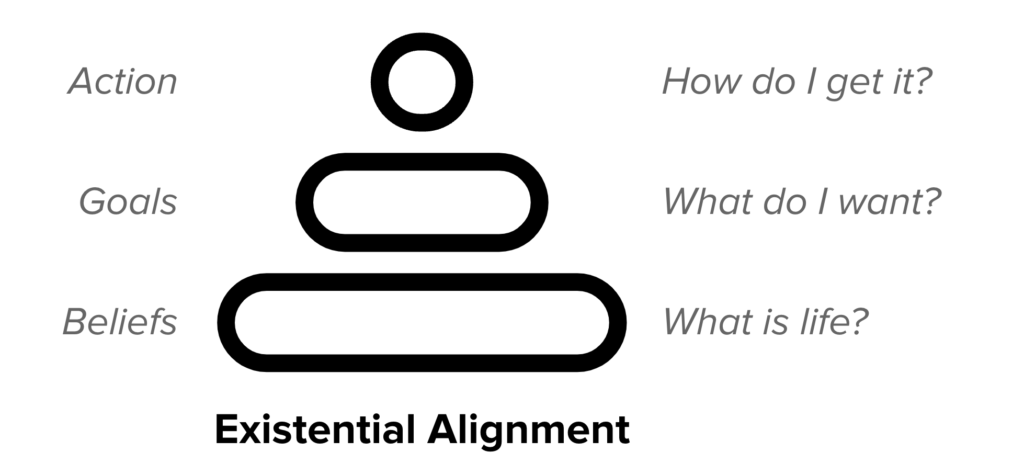
These are both examples of my pursuit of existential alignment. Existential alignment is the deepest level of self-awareness that arises when I know how what I am doing now is related to my core desire, which is in turn rooted in who, what, and where I am.
The larger part of my life spent without this alignment was a time of dissatisfaction and anxiety. Though I had achieved many of my worldly goals, I felt unmoored because they lacked grounding in a wider existential framework that made sense of them.
So I accomplished this goal. How does that relate to who I am?
Marc Ragsdale
Once I discovered what I believed on an existential level, it became easier to intentionally align my actions with my goals. I dispensed with the goals I had picked up along the way that did not contribute to my existential goals, and tore down the artificial wall I had built between my personal and professional identities. Because I can now draw a straight line from my daily actions down to my core beliefs, there are no obstructions to either my writing or my work.
…
Every organization is in the race to autonomy
Autonomization is not a distant future. The race is on, and the organizations preparing today will be the ones that win tomorrow.